Easter Egg Cakes cooked in Egg Shells!

I absolutely adored the edible ‘turtle’ eggs I saw at the Tate & Lyle Tasting house earlier in the week, I also fell head over heels in love with the gingerbread creations. The only logical thing to do…. combine the two ideas with an Easter twist!

I used the new Tate & Lyle Taste Experience Dark Muscovado sugar in my gingerbread. It added a very moreish quality and gave the gingerbread a deep rich flavour, I would definitely recommend trying it out!

To make the Easter Eggs

Start by carefully making a small hole in the end of an egg, I used a sterilised needle.

Then carefully make the hole ever so slightly larger using the needle, or your fingers if you can pinch tiny bits.

Next I used a cocktail stick to break up the egg inside it’s shell. Drain out over a bowl, I washed out the eggs at this stage.

Decorating your Easter Eggs

Decorating eggs couldn’t be a simpler, all you need is approx 1/2 cup of room temperature water, add in about 1 Tbsp vinegar and then food colouring.

Dip your eggs in the colouring and keep turning until you have reached the desired shade. I used my handy egg dipper to pick them up. Place them on kitchen paper to dry.

Gingerbread Recipe

Of course you can fill the eggs with whatever cake takes your fancy, but if you like yummy squidgy gingerbread then this recipe is great.

100g/ 4oz Butter
100g/ 4oz Tate & Lyle Golden Syrup
100g/ 4oz Tate & Lyle Treacle
100g/ 4oz Tate & Lyle Taste Experience Dark Muscovado Sugar
275g/ 10oz Self Raising Flour
2 Tsp Ground Ginger
1 Tsp Ground Cinnamon
2 Beaten Eggs
225ml/ 7 to 8 floz Milk

Melt the butter, syrup, treacle and sugar gently in a pan. Leave to cool slightly.

Sieve together the flour, ginger and cinnamon.

Add the melted sugar mixture to the flour and beat.

Beat in the egg and milk.

Filling the Egg Shells

Preheat the oven to 160C/ 325F/ Gas Mark 3

Take each on your dyed eggs and wrap the base in a square of foil with the hole facing upwards. Place them gently into a muffin tin.

Fill a piping bag with your cake mixture and carefully pipe the cake batter into the hole in your egg.

Try to fill the eggs about 3/4 of the way up.

Bake them for about 20 minutes. If some of the cake oozes out of the top (as it did on a few of mine) then just nip those pieces off with your fingers.

Leave to cool and then present in an egg box :)


Easter Egg Knitting Pattern Tutorial

With Easter just around the corner there’s every chance that you are looking forward to baskets laden with chocolate eggs and gatherings with your family.

But what if you don’t like chocolate!? Or you’re on a diet and avoiding sugar!? Need you suffer an eggless day with little to bring you cheer? Here at Angel Eden we say no, we think you should knit yourself some calorie free Easter Egg decorations with our brand new pattern :)

In fact we think you should knit them even if you are endulging in chocolate, we like them that much!

The Pattern

The eggs were knitted using DK yarn and size 4mm(8) needles.
They could be made larger by using a bigger yarn and needles.

The eggs are knitted in stocking stitch, one row plain and the next purl.

Cast on 10 stitches
Row 1 Purl
Row 2 Knit 1, Kfb (Knit into the front and back of each stitch) all the remaining stitches, (19sts)
Row 3 Purl
Row 4 Knit 2, Kfb (Knit into the front and back of each stitch) all the remaining stitches, (36sts)
Row 5 Purl
Row 6 Knit
Row 7 Purl
Row 8 Knit 1, (Kfb, K1) repeat until last stitch, K1, (53 sts)
Row 9 Purl
Rows 10 – 25 continue in stocking stitch and pattern as desired. The pattern could be different coloured stripes or spots or zig zags.
Row 26 (K2, K2Tog) repeat to end of row, K1(40sts)
Row 27 Purl
Row 28 Knit
Row 29 Purl
Row 30 (K1,K2Tog) repeat to the end of the row, K1 (27sts)
Row 31 Purl
Row 32 Knit
Row 33 Purl
Row 34 K1, (K2Tog) to end of row, (14sts)
Row 35 Purl
Row 36 Knit
Row 37 Purl
Row 38 (K2Tog) to end of row, (7sts)

Cut the yarn and thread through the last 7 stitches and pull up. Sew down the side of the egg and then stuff with toy stuffing. Finish off by running some yarn round the cast on edge and complete sewing up.

Advent Calendar Sewing Tutorial

With the festive season fast approaching I decided to share my tutorial to sew your very own advent calendar! I originally wrote this for the Boden Community which has now become the Boden Blog. You might just be able to find it if you scour through the archives, but it seemed far simpler to share it direct with my readers over here.

You Will Need

A hanger (I chose a lovely old wooden one)
2 pieces of fabric to make the background (mine measured 34cm X 48cm but this may vary depending on the size of your hanger)
1 piece of fleece fabric 34cm X 48cm
4 pieces of ribbon approximately 28cm in length
35cm piece of ric rac or ribbon
5 pieces of fabric measuring 12cm X 36cm each
24 mini luggage labels
24 mini gold safety pins
24 Sweets of your choosing.

Step 1

Begin by pinning the two background pieces of fabric together (right sides facing). Then place on top of the fleece fabric (I used an old blanket to cut the fleece from). Sew down one long side, across the bottom and back up the other side, leaving the top free. Iron the pieces together and then trim the fleece back close to your stitches, also trim the corners to aid turning.

Step 2

Turn the fabric the right way out and iron flat again, tuck in approximately 1cm of fabric at the open edge and iron ready for sewing. I chose to hang the calendar using pretty ribbon. Fold the 4 pieces of ribbon in half and tuck into the top open edge of your calendar. Sew across the open edge of the calendar, making sure to catch the ribbon as you go. For a little extra decoration I laid a piece of matching ric rac across my stitches at the top and sewed into place (ribbon would also work). You’ve now completed the background piece.

Step 3

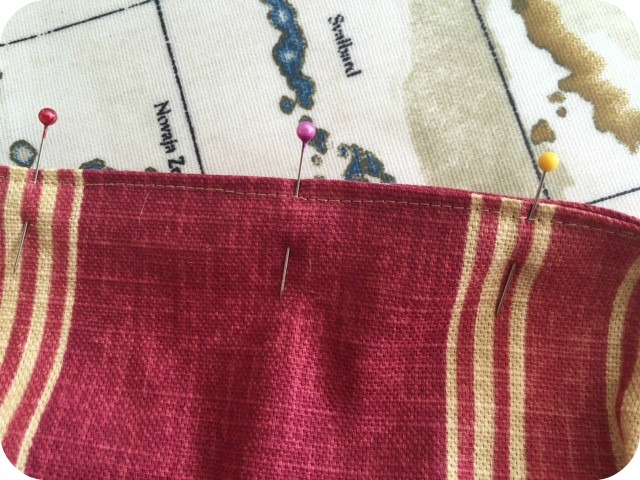
Time to make the pockets! On each piece of fabric turn over 1cm of fabric along one of the longer sides. Iron and then turn another cm over and iron again, this is the top edge of each set of pockets. Now turn each remaining edge over 1cm and iron. Machine stitch just the top edges of the pockets, leaving the other edges free.

Step 4

Position each set of pockets evenly across the background fabric and pin. Machine stitch across the bottom of each pocket and then around the entire edge of the calendar. You will now have 5 large pockets. In my example the first 4 rows have 5 pockets and the final row has 4 larger pockets. To create this you need to machine across each large pocket several times to make smaller pockets. On the first four rows I did this at approximately 6 ½cm intervals. On the final row I sewed at approximately 8cm intervals.

Step 5

To make the calendar numbers I bought some small luggage labels from a Stationary shop. I cut them down just slightly to make them smaller. Using a red and green crayon I then stencilled a number onto each label. These are then pinned to each pocket on the calendar using mini gold safety pins (again picked up from a Stationary shop).

Step 6

Decide who the calendar is for and fill each pocket with an appropriate sweet or gift. It could even serve two or three lucky recipients, just pop a couple of extra sweets in each pocket. Now you have an attractive and reusable advent calendar that should serve you for many years to come.